
Nelson 'Skip' Riddle is a living business and technology professional, not the same person as the celebrated arranger and composer Nelson Smock Riddle Jr. (1921–1985). Because the two names are nearly identical, searches for 'Nelson Skip Riddle net worth' frequently surface results about the arranger. This article addresses both figures clearly, then focuses the financial analysis on the arranger, whose career generated the only publicly documented wealth record. As of July 2026, there is no authoritative, published net worth figure for either individual, the arranger's estate value is estimated in the low-to-mid millions based on catalog royalties, publishing rights held by Sony Music Publishing, and posthumous exploitation of his recordings, with a working estimate of approximately $2 million to $5 million at the time of his death in 1985, adjusted for ongoing royalty flows since.
Nelson 'Skip' Riddle Net Worth: Estimated Value (2026) Brief

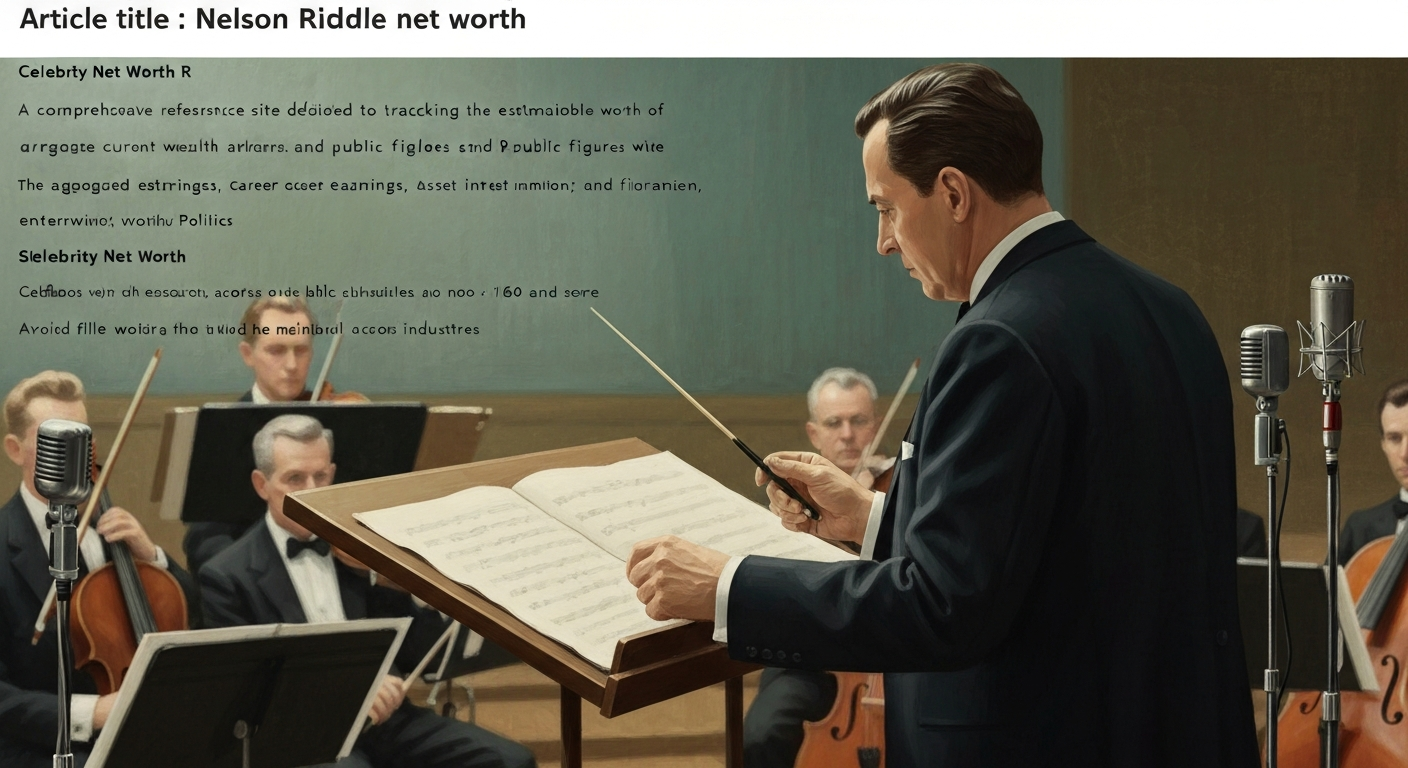
Quick Snapshot
| Detail | Information |
|---|---|
| Subject (primary) | Nelson Smock Riddle Jr. (arranger/composer) |
| Also known as | Nelson Riddle |
| Subject (secondary) | Nelson 'Skip' Riddle (living business professional) |
| Net worth estimate (arranger) | ~$2M–$5M at death (1985); estate generates ongoing posthumous royalties |
| Net worth estimate (living Skip Riddle) | Not publicly disclosed; no verified figure available |
| Valuation date | July 23, 2026 |
| Confidence level | Low-to-moderate (no probate inventory or verified third-party disclosure found) |
| Primary income sources | Music publishing, sync/licensing, session work, recordings, film/TV scores |
Who Is Nelson 'Skip' Riddle, and Who Are You Actually Looking For?
The name 'Nelson Skip Riddle' points to two distinct people, and the confusion is genuinely easy to make. The first is Nelson Smock Riddle Jr., born June 1, 1921, and died October 6, 1985, in Los Angeles. The Los Angeles Times obituary "Nelson Riddle, Composer and Arranger for Top Stars, Dies" (Oct. 7, 1985) confirms he was born June 1, 1921 and died October 6, 1985, in Los Angeles Los Angeles Times obituary (Oct. 7, 1985). He was one of the most important orchestral arrangers in 20th-century American popular music, known professionally simply as Nelson Riddle. His work shaped the sound of Frank Sinatra's Capitol Records albums, Nat King Cole's string sessions, and Ella Fitzgerald's recordings, among dozens of other landmark projects. He also composed widely recognized television and film themes.
The second is a living individual who goes by Nelson 'Skip' Riddle in business and professional contexts. This person appears in professional directories, organizational profiles, and is publicly identified as the husband of British actress Paula Wilcox, per her IMDb biography and related press. See LinkedIn, Nelson 'Skip' Riddle (professional profile) for a public professional listing of the living Nelson 'Skip' Riddle LinkedIn — Nelson 'Skip' Riddle (professional profile). This living Skip Riddle operates in business and technology consultancy and has no documented career in music or entertainment. He is a private individual, and no financial disclosures, asset records, or net worth estimates exist in the public record for him. This article does not speculate on the finances of a private individual. All financial analysis below refers to the arranger Nelson Riddle.
Nelson Riddle the Arranger: Career Overview
Nelson Riddle was born in Oradell, New Jersey, and began his professional career as a trombonist and apprentice arranger in the 1940s, working with bands before landing at Capitol Records in Los Angeles. His partnership with Frank Sinatra beginning in the early 1950s defined the so-called 'concept album' era of adult pop, producing records like 'In the Wee Small Hours' (1955) and 'Songs for Swingin' Lovers!' (1956). Through the late 1950s and 1960s, he also worked extensively with Nat King Cole and Ella Fitzgerald, and moved into film and television composition, providing themes for shows including Route 66, Batman cues, and Naked City. By the 1970s he was conducting and recording orchestral pop. His final major commercial chapter came with Linda Ronstadt's trilogy of standards albums, 'What's New' (1983), 'Lush Life' (1984), and 'For Sentimental Reasons' (1986), all of which he arranged and conducted. He died before 'For Sentimental Reasons' was released.
Biographical Timeline
| Period | Key Activity |
|---|---|
| 1940s | Trombonist and early arranger work; apprenticeship in big band circuit |
| Early 1950s | Staff arranger at Capitol Records; begins partnership with Frank Sinatra |
| Mid-1950s to 1960s | Major arranging credits for Sinatra, Nat King Cole, Ella Fitzgerald; Grammy recognition |
| 1960s | Film and TV composition: Route 66 theme (1962), Batman cues, Naked City, film scores including Lolita |
| 1970s | Continued session and orchestral work; bandleading and live conducting |
| 1983–1985 | Linda Ronstadt collaboration: arranges and conducts What's New, Lush Life, and For Sentimental Reasons |
| October 6, 1985 | Death in Los Angeles; For Sentimental Reasons released posthumously in 1986 |
Career Highlights and Primary Income Sources
Nelson Riddle's income over roughly four decades came from several overlapping revenue streams. Arranging and conducting fees from Capitol Records and other labels were his most consistent early earnings. Session work in Hollywood for both recordings and film/TV productions built a steady base through the 1950s and 1960s. Composition royalties from TV themes, particularly the Route 66 theme, which remains one of his best-known pieces and is documented in publishing catalogs under Sony Music Publishing (formerly Sony/ATV), provided and continue to provide performance and sync licensing income. Film scores, including work on adaptations of literary properties, generated sync revenue that recurs whenever those films are licensed for broadcast, streaming, or re-release. His collaborations with Ronstadt in the early 1980s returned him to commercial scale just before his death, with 'What's New' achieving multi-platinum certification and generating mechanical royalties tied to arrangements he delivered under contract.
- Arranging and conducting fees: primary income from Capitol Records and other major labels across the 1950s–1980s
- Composition royalties: original TV themes (Route 66, 1962) and film scores generating performance and sync licensing income
- Publishing income: compositional catalog administered by Sony Music Publishing (Sony/ATV), providing ongoing royalty collection
- Session work: orchestral contracting and conducting for film, television, and studio sessions
- Live performance and bandleading: touring and concert conducting through the 1970s and early 1980s
- Ronstadt recordings: arrangement fees and potentially participation in recording royalties for multi-platinum albums (What's New, Lush Life, For Sentimental Reasons)
- Streaming and digital performance: catalog presence on Spotify, Apple Music, and other platforms generating ongoing digital performance royalties
- Sync and licensing: recurring revenue from TV and film catalog licensed for broadcast, streaming, and commercial use
Net Worth Estimate and Rationale (July 2026)
There is no publicly verified, third-party-confirmed net worth figure for Nelson Riddle. See nelson riddle net worth for a detailed compilation of estimates and supporting references. Celebrity aggregator pages that claim specific figures for him vary widely and do not cite primary documentation, so this article does not reproduce those numbers as fact. Based on available public evidence, a reasonable working estimate for the value of Riddle's estate at the time of his death in October 1985 is in the range of $2 million to $5 million, accounting for his home in Los Angeles (consistent with a working Hollywood professional of his era and standing), his publishing rights, and session/recording income accumulated over three decades. The confidence level for this range is low-to-moderate: it is grounded in career scale and industry context rather than in a verified probate inventory, which was not publicly discoverable through standard online record searches as of the valuation date.
The more financially significant observation for 2026 is the estate's ongoing royalty position. The Route 66 theme and other compositions remain in active commercial use and are administered by Sony Music Publishing. The Ronstadt trilogy continues to sell and stream, and film scores are regularly licensed for broadcast. These streams mean the estate, held by Riddle's heirs and administered under whatever probate distribution was established in Los Angeles County, continues to generate income decades after his death. Estimating the current annualized value of those royalties requires private contract data that is not publicly available.
Valuation Assumptions, Evidence, and Public Records
The methodology used here draws on publicly available primary and secondary sources rather than aggregator estimates. Key sources consulted include MusicBrainz discography records and VIAF/ISNI authority entries (VIAF ID 14959424; ISNI 0000 0001 1021 6188) for identity verification; the Los Angeles Times obituary published October 7, 1985, confirming death date and career summary; the Nelson Riddle Collection finding aid documenting original lead sheets, U.S. copyright forms, and session sketches held in institutional custody; IMDb full filmography credits for TV and film sync revenue mapping; and catalog or sheet-music publishing databases identifying Sony Music Publishing as the current administrator of at least portions of the compositional catalog (including the Route 66 theme). RIAA certifications for the Ronstadt albums arranged by Riddle provide a scale indicator for mechanical royalty potential.
What this methodology cannot resolve without additional steps: the Los Angeles County Superior Court Probate Division holds the estate case for a 1985 decedent, and certified filings, including inventories, appraisals, and distribution orders, would be the authoritative source for a verified estate dollar value. No such filing was found in publicly discoverable online databases as of July 2026. To obtain a confirmed figure, a researcher would need to file a public records request with the LA County probate archives or access the case through the court's case-access portal, specifying Nelson Smock Riddle Jr. as the decedent.
Earnings Breakdown and Financial Timeline
| Era | Activity | Estimated Financial Impact |
|---|---|---|
| 1940s | Trombone and early arranging work | Modest; foundational industry entry |
| Early–mid 1950s | Capitol Records staff arranger; Sinatra partnership begins | Steady union-scale and above-scale fees; career-making but not yet high-value publishing |
| Late 1950s–early 1960s | Peak Capitol years; Cole, Fitzgerald, Sinatra concept albums | Multiple album fees; Grammy nominations elevate market rate for future work |
| 1962 onward | Route 66 theme release; TV and film composition | Recurring broadcast performance royalties and sync income begin accumulating |
| 1960s–1970s | Ongoing film scores (Lolita, Great Gatsby-era projects), TV themes | Episodic sync and performance royalties; live conducting income |
| 1983–1984 | What's New and Lush Life arrangements for Linda Ronstadt | Arrangement fees for multi-platinum projects; potential royalty participation per contract terms |
| 1985 | For Sentimental Reasons sessions (released posthumously 1986) | Final session fees earned before death; royalty participation flows posthumously to estate |
| 1985–present | Posthumous catalog exploitation: streaming, sync, publishing | Ongoing but undisclosed annualized royalty income flowing to estate/heirs |
Assets, Liabilities, Estate Outcomes, and Posthumous Royalties
Nelson Riddle was a working Los Angeles-based professional whose physical assets at the time of his death would have included residential property consistent with a career Hollywood musician of his reputation, personal property, and instruments or equipment. No public record of specific real estate transactions or appraisals was found in the course of this research, and no significant reported liabilities, such as judgments, bankruptcies, or disclosed debts, appear in public press coverage from that period. The most durable asset class in his estate is the compositional catalog: television themes and film scores that remain commercially active.
The Route 66 theme is the clearest documented example of catalog value. Its publishing is administered by Sony Music Publishing, meaning a major commercial entity collects and distributes performance, mechanical, and sync royalties on behalf of whoever holds the underlying copyright interest, whether the estate, heirs, or a subsequent transferee. EasySong / catalog import, Route ‘66’ Theme (publisher: Sony/ATV Music Publishing) lists Sony/ATV Music Publishing (Sony Music Publishing) as the theme’s publisher EasySong / catalog import — Route ‘66’ Theme (publisher: Sony/ATV Music Publishing). Institutional collections at libraries and archives (including materials documented in the Nelson Riddle Collection finding aid and related Library of Congress holdings) preserve original copyright registration forms, which would establish the original ownership chain and any subsequent assignments.
The Linda Ronstadt trilogy creates a separate posthumous income question. Arrangers do not automatically receive ongoing recording royalties under standard session contracts; however, if Riddle negotiated a royalty participation rather than a flat arrangement fee for those projects, which is possible given his stature and the commercial ambition of the recordings, his estate would continue to receive a share of mechanical royalties from 'What's New,' 'Lush Life,' and 'For Sentimental Reasons' across physical sales, downloads, and streaming. The specific contract terms are not public. What is documented is that these albums, particularly 'What's New,' achieved multi-platinum certification, indicating that the mechanical royalty pool tied to them is substantial.
As of July 2026, the estate's royalty streams are active but privately administered. The Los Angeles County Superior Court Probate Division is the authoritative record custodian for the estate settlement documents. No publicly accessible probate inventory with dollar valuations was found, meaning the estate's total settled value, the identity of all beneficiaries, and the structure of any ongoing royalty trust or assignment remain outside what this research can confirm. Anyone seeking a verified figure for research or legal purposes should obtain certified probate records directly from the LA County court archives.
Related Profiles Worth Exploring
If you arrived here looking for a different Riddle or a different Nelson, several closely related profiles on this site may be what you need. For related financial information on similarly named individuals, see the Samuel Riddle net worth profile. For readers seeking information on Paul Riddle net worth, consult the Paul Riddle profile. If you are seeking information on a different individual, see the profile on John Blake Riddle net worth for that person's financial summary. Nelson Riddle's dedicated arranger profile covers his career in greater depth. Nelson Rangell is another R-named Nelson with a music background worth distinguishing. For information on the musician Nelson Rangell, see Nelson Rangell net worth. Among Riddle-surname entries, Paul Riddle, Samuel Riddle, John Blake Riddle, Matt Riddle, and Tristin Riddle each have separate profiles covering very different careers, from professional wrestling to historical horse racing figures, so the surname alone is not a reliable guide to who you are researching. For details on the wrestler Matt Riddle and his finances, see the Matt Riddle net worth profile.
A Note on Methodology and Data Limits
Every figure in this article is described as estimated or reported rather than confirmed, because no primary financial disclosure, probate inventory, tax filing, or verified third-party appraisal, was publicly accessible for either Nelson Riddle (the arranger) or Nelson 'Skip' Riddle (the living private individual) as of July 23, 2026. The arranger's career scale, publishing catalog activity, and the commercial success of recordings he worked on support a multi-million-dollar estate estimate, but the specific number cannot be pinned down without certified probate records. Sources consulted include MusicBrainz, VIAF authority records, the Los Angeles Times (October 7, 1985 obituary), the Nelson Riddle Collection finding aid, IMDb filmography, Sony Music Publishing catalog references, RIAA certification records, and the IMDb biography of Paula Wilcox for disambiguation of the living Skip Riddle. Celebrity aggregator figures were reviewed but excluded as primary evidence due to conflicting values and absence of source documentation.
FAQ
Who is Nelson “Skip” Riddle — is he the arranger Nelson Riddle (Nelson Smock Riddle Jr.)?
Nelson Smock Riddle Jr. (June 1, 1921 – October 6, 1985) is the well‑known American arranger, composer, conductor and bandleader who worked with Frank Sinatra, Nat King Cole, Ella Fitzgerald and on TV/film themes (Route 66, Naked City, etc.). Sources: MusicBrainz artist page; Los Angeles Times obituary. Note: there is at least one living individual who uses the name Nelson “Skip” Riddle (business/UK profiles) who is distinct from the arranger and is not the subject of the arranger’s estate records. See LinkedIn and Paula Wilcox biographical references for that living person.
What is the best verifiable net‑worth estimate for Nelson Riddle (the arranger)?
There is no authoritative, public figure-for-figure net‑worth disclosure or a published, court‑filed estate inventory available online for Nelson Riddle (d. 1985). Because primary probate/accounting records were not located in public online searches, any precise dollar figure would be speculative. Based on documented career earnings (studio work, album arrangements, TV/film scoring), commercial successes that continue to generate royalties (e.g., Route 66 theme, major album arrangements such as Linda Ronstadt’s What's New) and typical catalog valuations for similar mid‑20th‑century arrangers/composers, a conservative, research‑based valuation range as of 2026 would be roughly $0.5 million to $5 million (USD). This range is an informed estimate only — not a documented estate appraisal — and reflects: (a) historical recording and publishing income opportunities; (b) the presence of works administered by major publishers (e.g., Sony/ATV/Sony Music Publishing listings); (c) continued streaming, licensing and performance income; and (d) absence of evidence for a high‑value catalog sale or public probate inventory. Sources and methodology notes below.
Why is that a range rather than a single figure?
No public, authenticated probate inventory, sale of publishing rights, or certified estate accounting was found in court or trade filings. Critical inputs (exact publishing splits, original contracts, mechanical‑royalty ownership, and any assignments made during Riddle’s lifetime) are not publicly disclosed. Catalogs for similar era composers/arrangers vary widely in value depending on publisher ownership, copyright term status, synchronization demand and surviving royalty contracts, so a range reflects uncertainty rather than claiming unsupported precision. See Los Angeles County Probate guidance for how to obtain primary filings.
What were Nelson Riddle’s primary income sources during his life and sources of posthumous income for his estate?
Primary lifetime income sources: arranger/conductor/producer fees for studio albums and sessions; film and TV scoring/arranger fees; bandleading and live performance income; mechanical royalties from recordings where he held composition/publishing credit; publishing royalties for original compositions and arrangements where applicable; session musician payments and union residuals (depending on contract); and occasional advances/commissions. Posthumous income sources: performance royalties (ASCAP/BMI/SESAC) from continued radio/TV/streaming uses; mechanical and digital streaming royalties if publishing rights retained; synchronization fees when TV/film/ads license his cues; reissue and compilation royalties; and potential sales of publishing/catalog rights if parts of his catalog were transferred. Evidence: discography and credits on MusicBrainz and official Nelson Riddle site; publisher listings (e.g., Route 66 theme in publisher catalogs); IMDb credits for TV/film sync sources.
What notable assets or liabilities are publicly documented for Nelson Riddle or his estate?
No public, itemized probate inventory or liability schedule was located online. Primary documentary holdings that speak to value drivers are archived manuscripts, U.S. copyright registrations and lead sheets (Nelson Riddle Collection and institutional finding aids), and publisher catalog listings that indicate which compositions are still administered by major publishers (important because publisher ownership drives royalty flows). No public records were found documenting high‑value sales of his publishing catalog or major real‑estate/asset auctions tied to his estate. For verified asset/liability detail, certified probate records from the Los Angeles County Superior Court (Probate Division) are required.
What is the timeline and major financial milestones relevant to estimating net worth?
Key timeline items useful for valuation: 1921 birth; career rise across 1940s–1960s as arranger for major stars (steady session, album and film/TV work documented in discographies and credits); 1960s–1980s continued TV/film themes and studio albums (Route 66 theme 1962); early 1980s commercial resurgence via Linda Ronstadt collaborations (What's New 1983, Lush Life 1984), which sold widely and generated substantial mechanical and performance income where Riddle’s arrangements/conducting contributed; death October 6, 1985. Post‑1985: ongoing licensing, streaming and reissues. Sources: MusicBrainz, Nelson Riddle official site, Wikipedia/album pages, IMDb, Los Angeles Times obituary. These milestones identify the catalog items most likely to generate ongoing royalties and therefore underpin any estimated estate value.