
Stuart Ripley's net worth is estimated at between £0.5 million and £2.0 million as of July 2026. See Ripley Alexander net worth for a concise summary of these estimates. That range is constructed from verifiable career data rather than a published wealth disclosure, because no major business or sports-finance outlet has placed a specific figure on record for him. His wealth draws from roughly 17 years as a professional footballer in the top flight, a transfer fee of around £1.3 million that confirms his market value during his peak, and a second career as a qualified solicitor and Football Association regulatory panel member that has been generating professional income since around 2010.
Stuart Ripley Net Worth 2026: Estimated Wealth & Assets Snapshot

Marcus Rothschild
18 Jul 2026
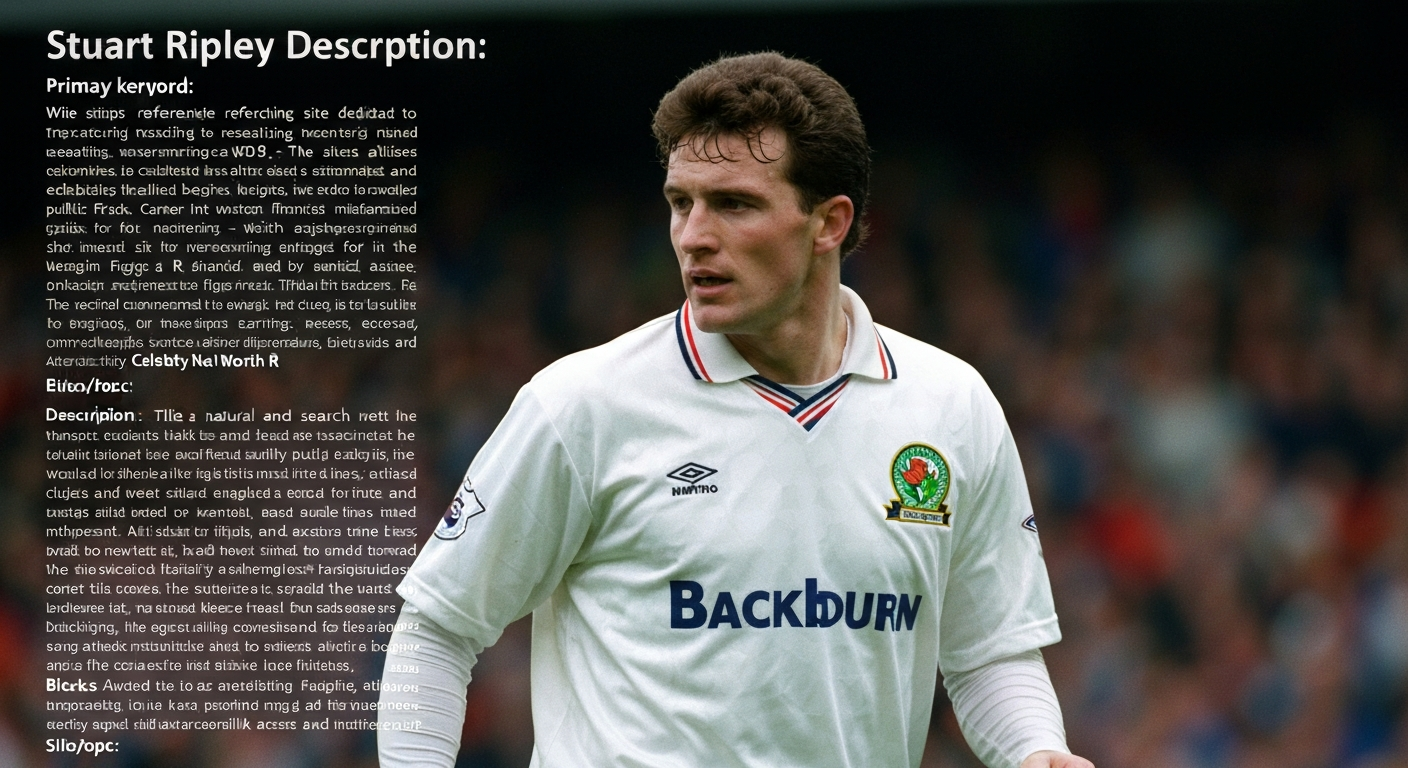
Net worth snapshot (July 2026)
| Detail | Figure |
|---|---|
| Estimated net worth range | £0.5 million – £2.0 million |
| Headline / midpoint estimate | ~£1.0 million |
| Last updated | 18 July 2026 |
| Basis | Inferred from career earnings, solicitor income, FA panel fees |
| Published wealth disclosure | None on record (Forbes, Sunday Times Rich List, BBC) |
The range is deliberately wide. Stuart Ripley has never appeared on a published wealth list, and his private salary and asset information is not publicly disclosed anywhere in company filings or press coverage. The figures above represent a conservative evidence-based inference, not a confirmed number, and should be read accordingly.
Supporting evidence behind the estimate
Several verified data points anchor the estimate. The Independent reported on 6 July 1992 that Blackburn Rovers were chasing Ripley, and season chronicle records confirm the transfer from Middlesbrough was completed on 8 July 1992 for a fee of approximately £1. Contemporary season timelines and league chronicles record the transfer as blank" rel="noopener noreferrer">completed on 8 July 1992 for a fee of approximately £1.3 million. 3 million. That fee is a concrete marker of his market value at the start of his highest-earning period. His time at Blackburn coincided with the explosive growth in Premier League wages through the mid-1990s, when top-flight average weekly pay rose sharply year on year according to published football-economics research. See The Football Industry and the Capitalist Political Economy, ResearchGate (historical table of average top‑flight pay by year) for published historical wage tables showing average top‑flight weekly pay rising sharply through the 1990s blank" rel="noopener noreferrer">The Football Industry and the Capitalist Political Economy — ResearchGate (historical table of average top‑flight pay by year). He was a full member of the Blackburn squad that won the Premier League title in 1994-95, so he was operating at the very top of English football during the wage boom.
On the post-retirement side, the evidence is equally concrete. UCLan records cited in his biography confirm he graduated in 2007 with a first-class degree in Law and French. LegalCheek reported in September 2012 that he had qualified as a solicitor and joined Manchester firm Brabners Chaffe Street, working in sports law. FA written-reasons documents from 2019 through the 2025-26 season list him as a member of Independent Regulatory Commission panels, confirming he has been earning professional fees in that capacity through at least 2026. None of these sources disclose salary figures, but collectively they confirm two distinct post-playing income streams running for over a decade.
Career summary
Ripley came through the ranks at Middlesbrough, making his debut there in 1985 and spending seven seasons at the club before his high-profile move to Blackburn. At Middlesbrough in the mid-to-late 1980s he was earning in line with the second and then first division norms of that era, which were modest compared with what was coming. The real financial step-change came with the Blackburn transfer in 1992, just as the Premier League's first Sky television deal was inflating wages across the top flight.
He spent six seasons at Ewood Park (1992-1998), where he was a regular on the right wing and part of the title-winning side. In July 1998 press reports, including an Irish Times item on Southampton's summer signings, confirmed his move to Southampton, where he stayed until 2002. During the Southampton years he had loan spells at Bolton, Barnsley, and Sheffield Wednesday. His career appearances across Middlesbrough, Blackburn, Southampton, and the loan clubs are documented in Transfermarkt, Soccerbase, and Wikipedia, though the exact totals vary slightly between databases. He retired from playing around 2002 and subsequently requalified completely, entering law.
Earnings timeline
| Period | Club / Role | Estimated Weekly Wage | Transfer Fee (reported) |
|---|---|---|---|
| 1985–1992 | Middlesbrough | ~£200–£600 pw (Div 1/2 era benchmark) | — |
| 1992–1998 | Blackburn Rovers | ~£1,500–£4,000 pw (PL wage growth era) | ~£1.3 million paid by Blackburn |
| 1998–2002 | Southampton + loans | ~£2,000–£4,000 pw (late PL 1990s benchmark) | Undisclosed (reported among summer signings) |
| 2002 onward | Retired from playing | — | — |
| 2007–2010 | UCLan / trainee solicitor | Trainee salary range (~£18,000–£25,000 pa) | — |
| 2010–2026+ | Solicitor / FA panel member | Solicitor mid-range + panel fees (est.) | — |
The wage figures in the table are benchmarks drawn from published football-economics research on 1990s Premier League pay and standard solicitor salary ranges. They are not Ripley's disclosed figures. They are included to show the order of magnitude at each career stage, not to assert precise personal earnings.
Post-retirement income streams
Ripley's post-retirement financial life is notably different from most former players because it is built on professional qualifications rather than media work. After finishing at Southampton around 2002, he returned to education and by 2007 had achieved a first-class combined honours degree in Law and French from UCLan. He then completed a legal practice course and training contract, qualifying as a solicitor by 2010 and joining Brabners Chaffe Street in Manchester, where he worked on sports law matters. This placed him in a sector where his footballing contacts and experience added practical value.
Alongside his legal practice, he has held appointments as an Independent Member on FA Regulatory Commission panels, which adjudicate disciplinary matters. FA written-reasons documents confirm his participation through at least the 2025-26 season. These appointments carry fees for each panel sitting and represent a continuing, if irregular, income stream on top of any salaried legal work. No punditry, coaching, or public endorsement work for Ripley has been documented in the sources reviewed for this profile.
Known assets and financial holdings
There are no publicly available Land Registry, Companies House, or disclosed investment records that can be directly linked to Stuart Ripley in the sources reviewed for this profile. No property portfolio, business directorships, or investment holdings have been reported in press or business databases. This does not mean such assets do not exist; it means the public record simply does not document them. What can be reasonably inferred is that a player who worked at top-flight level from 1992 to 2002 and subsequently pursued a second professional career in law would have had the earnings basis to accumulate modest private savings, a pension, and potentially residential property, but none of these are confirmed by public filings.
- Property: no publicly documented residential or commercial holdings linked to Ripley
- Business interests: no Companies House directorships identified in sources reviewed
- Pension: likely to have an occupational football pension (Professional Footballers' Association scheme) plus personal pension contributions during legal career; amounts undisclosed
- Investments: no disclosed portfolio or shareholding on the public record
- Legal career earnings: accumulated professional income from solicitor work at Brabners Chaffe Street from around 2010 onward
Major financial milestones
- July 1992: Move from Middlesbrough to Blackburn Rovers for approximately £1.3 million. This was the single largest capital event verifiably linked to Ripley in the public record and marked the start of his highest-earning period as a player.
- 1994-95: Part of the Blackburn Rovers Premier League title-winning squad. Playing in a championship-winning team at this stage of PL wage growth would typically have carried a significant bonus clause.
- July 1998: Transfer to Southampton. The move is documented in contemporaneous press but the fee was not publicly disclosed; it marked the start of the final phase of his playing career.
- 2002: Retirement from professional football and transition to education, representing the end of player-era income.
- 2007: First-class degree in Law and French from UCLan, the academic foundation for his second career.
- 2010: Qualification as a solicitor and appointment at Brabners Chaffe Street, opening a sustained professional income stream.
- 2012 onward: Documented involvement in FA disciplinary panels, adding a recurring secondary professional income alongside legal practice.
- 2019-2026: Continued FA Regulatory Commission panel appointments confirmed through written-reasons documents, indicating sustained professional activity.
How this estimate was put together
The £0.5 million to £2.0 million range was built from the ground up using the verified data points available, rather than from any published wealth figure. The approach works in four steps: (1) establish career duration and level of play using Wikipedia, Transfermarkt, and Soccerbase; (2) apply published football-economics benchmarks for 1990s Premier League wages as a proxy for playing-era earnings, since individual salary data are not publicly available; (3) factor in the confirmed post-retirement professional income from a solicitor career beginning around 2010 and FA panel fees continuing to at least 2026; and (4) apply a conservative deduction for income tax, National Insurance, living costs, and the general absence of documented high-value asset accumulation. No inflation adjustment is applied to the range itself because the uncertainty in the inputs already exceeds the effect of CPI conversion at this level of precision.
The lower bound of £0.5 million reflects a scenario where spending was relatively high during the playing years and the legal career income has been modest. The upper bound of £2.0 million reflects a scenario where the peak Blackburn wages were at the higher end of the era benchmark, bonuses were material, and legal and panel income has accumulated meaningfully over 15-plus years. The midpoint of around £1 million is offered as the single most plausible figure, but even that should be treated as an informed inference rather than a verified sum.
Data limitations and confidence level
The confidence in this estimate is moderate-to-low. No major wealth publication, Forbes equivalent, or Sunday Times Rich List entry for Ripley was located in the research. No company filings, property registry entries, or personal financial disclosures have been identified in the public record. Individual Premier League salary data from the 1990s is largely private, meaning the wage benchmarks applied are sector-level proxies, not Ripley's actual contracts. Taxation rates, lifestyle spending, savings behaviour, and any business losses or gains are entirely unknown. Any new verifiable disclosure, such as a Companies House filing, a Land Registry entry, or a salary disclosure, could shift the estimate considerably. Readers should treat the range as directional rather than precise.
Reference sources used
- The Independent, 6 July 1992: 'Football: Rovers chase Ripley' (transfer fee reporting)
- The Irish Times, 11 July 1998: 'Soccer News: Hughes signs for Southampton' (listing Ripley among Southampton recruits)
- FourFourTwo retrospective: 'Not a fairytale story: Why Blackburn's unlikely Premier League title win still matters' (1994-95 title confirmation)
- Stuart Ripley — Wikipedia (career summary, clubs, appearances, UCLan graduation reference)
- LegalCheek, 14 September 2012: 'Rookie solicitor … nets spot on John Terry FA disciplinary panel' (qualification and Brabners appointment)
- The FA — Independent Regulatory Commission written reasons (2019-2026 panel listings)
- Transfermarkt — Stuart Ripley profile (transfer history and career statistics)
- Soccerbase — Stuart Ripley appearance record
- ResearchGate / football-economics research: historical tables of average top-flight pay by year (wage benchmarks)
Ripley in context: other R-named profiles
Ripley's financial profile sits in interesting contrast to other figures covered on this site. His career is a useful comparison point for former footballers who built post-sport professional lives rather than moving into media or coaching. For readers exploring similar profiles, the site covers other athletes and public figures whose names begin with R, including those in football and beyond. See the Will Ripley net worth profile for a direct comparison with another athlete's post-career finances. See the Tom Ripley net worth profile for a contrasting case study. For a contrasting example, see the profile on Alex Rance net worth for another documented football-to-post-career financial trajectory. For a contrasting case study, see the Victor Riparbelli net worth profile for an alternative example of a post-career financial trajectory. The career arc from top-flight footballer to qualified solicitor and FA regulatory panel member is relatively uncommon, which makes Ripley's financial story somewhat distinctive compared with contemporaries who stayed within the football industry after retiring.
FAQ
What is Stuart Ripley’s current estimated net worth (dated range)?
Estimated net worth (conservative, evidence‑based range as of 18 July 2026): £0.5 million – £2.0 million. This is an inferred range (not a published figure) based on documented top‑flight playing career (1985–2002), contemporaneous transfer fees (Blackburn paid ~£1.2–1.3m in July 1992), sector wage benchmarks for 1990s Premier League players, and verified post‑playing professional income as a qualified solicitor and FA panel member. Key sources: The Independent (1992 transfer), LegalCheek (solicitor profile), The FA written‑reasons (panel membership). See full methodology and references in the article.
How was the estimate calculated — what methodology and assumptions were used?
Methodology (summary): 1) Assemble verifiable cash‑flow anchors: documented transfers, club tenure and competition level (Middlesbrough, Blackburn Rovers, Southampton); 2) Apply historical wage benchmarks for Premier League/First Division players in the 1990s to produce conservative career‑earnings proxies (academic wage studies and industry tables used as benchmarks); 3) Add plausible post‑retirement professional income (solicitor employment, FA panel fees/appointments, approximate salaried roles) from 2007 onward; 4) Subtract estimated lifetime taxes and living costs at conservative rates to produce a range rather than a precise figure. Major assumptions: no public salary disclosures; no confirmed property sales or Companies House filings linking substantial business assets to Ripley; no access to private bank, tax, or pension records. The wide range reflects these uncertainties. Relevant source examples: The Independent (1992), Transfermarkt/Soccerbase (career stats), LegalCheek (solicitor), The FA documents (panel membership).
What verifiable evidence supports the estimate from his playing career?
Primary verifiable playing‑career evidence: - Documented clubs and seasons (Middlesbrough 1985–1992; Blackburn Rovers 1992–1998; Southampton 1998–2002) — Transfermarkt, Soccerbase, Wikipedia (career summary). - Verified contemporaneous transfer‑fee reporting: Blackburn paid ~£1.2–£1.3m for Ripley in July 1992 (The Independent, 6–8 July 1992; 1992–93 season chronicles). - Team success: member of Blackburn’s 1994–95 Premier League title‑winning squad (contemporary club/press records, FourFourTwo retrospective). Transfer fees and club level serve as anchors but are not direct evidence of personal net receipts; salaries were estimated from period wage benchmarks.
What post‑retirement income sources are documented?
Documented post‑playing roles that imply professional income: - University qualification: first‑class combined honours in Law and French from the University of Central Lancashire (reported; graduation c.2007). - Solicitor qualification and employment: qualified around 2010 and worked in sports‑related legal practice (LegalCheek profile and related interviews). - Regulatory/judicial roles: appointed as an independent member on FA disciplinary/independent regulatory panels (FA written‑reasons PDFs list Ripley on panels through 2025–26). These sources indicate recurring, salaried or fee‑based income streams, but the documents do not disclose precise pay rates.
Are there known assets (property, investments, pensions) publicly linked to Ripley?
No public, conclusive property or high‑value investments were found in the searches conducted. Land Registry, Companies House filings or press reports linking specific high‑value assets to Stuart Ripley were not located in the cited sources. Pensions and private investment holdings are not publicly disclosed; therefore the estimate excludes any unverifiable large asset holdings and remains conservative. If new public filings (Land Registry/Companies House) appear, the profile should be updated.
What are the main uncertainties and limitations in this net‑worth profile?
Key uncertainties: - No published, dated net‑worth figure from major outlets (Forbes, Sunday Times Rich List etc.) — absence documented. - No public salary contracts or personal tax returns; transfer fees are club payments and do not equal net player income. - Private assets (property, pensions, investments) not publicly traceable in available records. - Post‑retirement income amounts (solicitor salary, FA panel fees) are not disclosed in primary documents. These limitations are why the article gives a wide, conservative range and explains the inference method rather than asserting a precise figure.